Ruth Greenaway-Robbins

An Anglican Priest sharing sermons, musings and thoughts

  • John 18–19 | Psalm 22:1–11 | Hebrews 10:16–25 | Romans 8:31-39

    Today is not an easy day.

    Good Friday confronts us with the rawest edges of human experience:
    grief, abandonment, brutality, injustice.
    We have just heard it in the Passion according to St John,
    betrayal, denial, violence, humiliation, death.

    It is stark.
    It is uncomfortable.
    It hurts.

    And perhaps that is part of the truth of today:
    that we are not meant to rush past it.

    Psalm 22 gives us words for this moment:
    “My God, my God, why have you forsaken me?”

    This is not distant suffering.
    This is not theoretical pain.
    This is the cry of one who feels utterly alone.

    And if we are honest, it is a cry many of us recognise.

    Because Good Friday does not just tell us about Jesus’ suffering,
    it brings us face-to-face with our own.

    The grief we carry for those we have lost.
    The relationships that have broken or never healed.
    The quiet burdens of shame or regret.
    The exhaustion of living in a world where injustice feels relentless.

    All of it comes close to us today.

    And yet,
    and this is where it becomes almost too much to comprehend,
    this same moment, this same cross,
    is also the place where love is most fully revealed.

    It feels incongruous.

    How can it be
    that in the midst of such brutality
    we encounter the deepest, most profound love?

    And yet we do.

    We see it even within the Passion itself.

    In the midst of agony,
    Jesus looks down from the cross
    and sees his mother,
    and the disciple whom he loved.

    And he says:
    “Woman, here is your son.”
    “Here is your mother.”

    Even now.
    Even here.
    Even as everything is falling apart,

    love breaks through.

    Relationship is formed.
    Care is given.
    A new family is created.

    This is not love as sentiment.
    This is love as self-giving, costly, unrelenting presence.

    And this is the love that the cross reveals.

    There is a prayer that many of you will have been praying this Lent if you use the daily prayer app/podcast Pray As You Go.

    It is a prayer from St. Ignatius of Loyola, often called the Suscipe:

    You have given all to me
    To you, Lord, I return it
    Everything is Yours
    Do with it what You will
    Give me only Your love and Your grace
    That is enough for me

    It is a simple prayer.
    But it is also a radical one.

    Because it is a prayer of surrender.
    A prayer of letting go.
    A prayer of trust.

    And today, on Good Friday,
    we begin to see why such a prayer is possible.

    Because before we are ever asked to give anything to God,
    God has already given everything to us.

    That is what the cross shows us.

    Christ holds nothing back.
    Not his dignity.
    Not his safety.
    Not even his life.

    “You have given all to me…”

    Good Friday tells us: yes.
    God has.

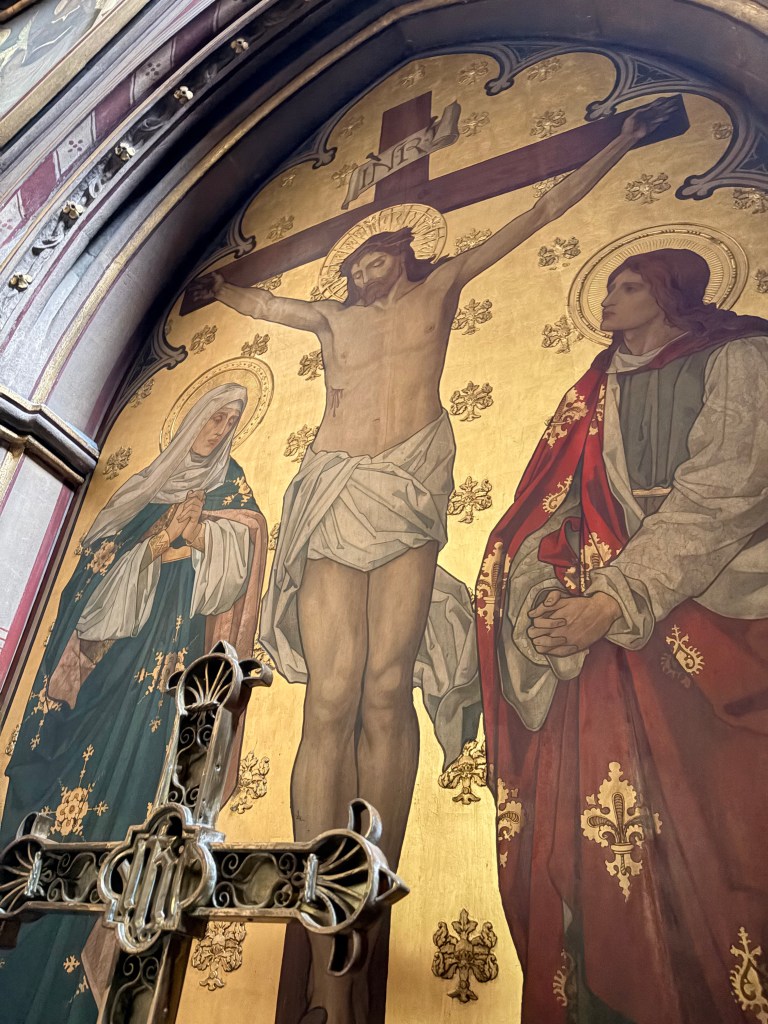
    The Rood at St. Andrew N16

    But here is where it becomes deeply personal.

    Because the cross is not only something we look at.
    It is something we are invited into.

    The letter to the Hebrews tells us that through Christ,
    a new and living way has been opened.
    That we can draw near with full assurance of faith.

    Draw near.

    Not stand at a distance.
    Not watch from afar.
    But come close.

    And in a few moments, we will do exactly that.

    We will come forward to venerate the cross.

    Some of us may bow.
    Some may genuflect.
    Some may kneel or even prostrate.
    Some may kiss the feet of Christ.

    And it is important to say:
    we are not worshipping the wood of the cross.

    We are responding to what it represents
    the love of Christ,
    the sacrifice of Christ,
    the offering of Christ.

    FOR THE LOVE.

    But veneration is only part of what is happening.

    Because the cross is not only a place of recognition
    it is a place of release.

    And this is where the Suscipe prayer becomes real for us.

    “You have given all to me
    To you, Lord, I return it…”

    As we come to the cross,
    we are invited not only to honour Christ’s offering
    but to bring our own.

    To lay down
    that which we have been carrying.

    The grief.
    The shame.
    The guilt.
    The pain.
    The injustice.
    The exhaustion.

    All those things that weigh us down
    and quietly separate us from the life God longs for us to have.

    Because carrying these things endlessly
    is not what Christ asks of us.

    The cross is not just where Christ suffers for us,
    it is where we are invited to place our suffering with him.

    To let it be held.
    To let it be transformed.
    To let it be redeemed.

    There is a moment in the anointing of the sick where these words are spoken:

    “As you are outwardly anointed with oil,
    so may our heavenly Father grant you the inward anointing of the Holy Spirit. Of his great mercy may he forgive you your sins
    and release you from suffering.”

    Release you from suffering.

    That is what the cross is about.

    Not that suffering magically disappears
    but that it no longer defines us.
    No longer traps us.
    No longer separates us from love.

    Because at the cross,
    love is stronger than suffering.

    And this is why St Paul can say with such boldness:

    that nothing, nothing, 
    can separate us from the love of God in Christ Jesus.

    Nothing.

    Not death.
    Not life.
    Not angels or rulers.
    Not things present or things to come.

    Literally Nothing.

    And we might wonder – how can he be so sure?

    Because of this day.

    Because of the cross.

    Because here we see that there is nowhere we can go,
    no depth we can fall to,
    no pain we can carry,
    that Christ has not already entered into.

    And if Christ is there
    then love is there too.

    So today, as we come to venerate the cross,
    I invite you to do so with honesty.

    Come as you are.

    And as you come,
    hold before God whatever it is you carry.

    And perhaps, quietly, in your heart,
    pray the words of that ancient prayer:

    You have given all to me
    To you, Lord, I return it

    Return to God your grief.
    Return to God your shame.
    Return to God your fear.
    Return to God the burdens you were never meant to carry alone.

    Everything is Yours
    Do with it what You will

    Trust, perhaps just a little
    that God can hold it.
    That God can transform it.
    That God can redeem it.

    Give me only Your love and Your grace
    That is enough for me

    Because in the end,
    that is what Good Friday reveals.

    That love is given, completely,
    costly,
    without reserve.

    And that love is for us.

    For each of us.

    More than we can imagine.

    And as we leave this place today,
    we do not leave pretending everything is resolved.

    Good Friday does not rush to Easter.

    We leave still in the shadow of the cross.

    But we leave knowing this:

    that we are loved,
    that we are forgiven,
    that we are held.

    And that as we are released from what we carry,
    we are made free.

    free to love,
    free to forgive,
    free to live differently in the world.

    A world that so desperately needs
    people who know this love.

    So, come.

    Come to the cross.

    Come with all that you are.

    And lay it down.

    For Christ has given all to you.

    And his love
    his grace

    is enough.

    You have given all to me
    To you, Lord, I return it
    Everything is Yours
    Do with it what You will
    Give me only Your love and Your grace
    That is enough for me
    .

  • Tonight, we begin something we do not finish.

    Or perhaps more truthfully, tonight, we are drawn into something that has no end.

    The liturgy of this night does not conclude with a blessing or a dismissal. It simply… continues. Into darkness. Into silence. Into watchfulness. For tonight begins a liturgy that last 3 days, it is the beginning of the Triduum, which simply means 3 days.

    And so tonight is not just a service.
    It is an invitation to a journey.

    And it begins with an invitation to Eat. Pray. Love.

    Some of you may know the film Eat Pray Love, based on the memoir by Elizabeth Gilbert. It tells the story of a woman who, despite a life that appears successful and stable, finds herself deeply unsettled, searching for meaning, for healing, for something more. And so, she sets out on a journey: to Italy, where she learns again how to eat and delight in life; to India, where she learns to pray, often through discipline and struggle; and to Bali, where she learns to love, and to receive love without fear. It is, at its heart, a story of longing, transformation, and the slow rediscovery of what it means to be fully alive.

    And tonight, we too begin a journey.

    Not across continents, but into the heart of God. A story to of longing, transformation, allowing us to be fully alive.

    Eat

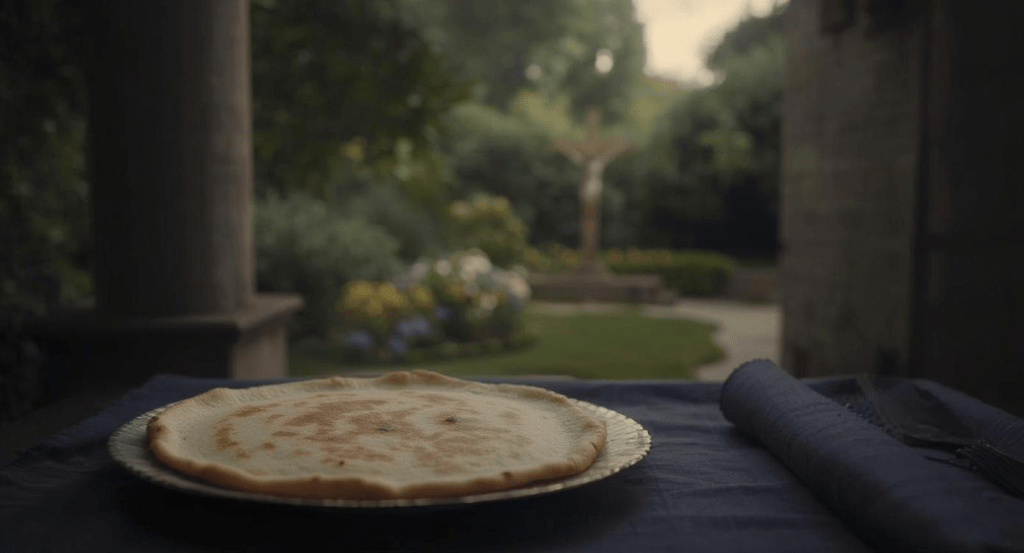
    We begin, as Jesus does, at the table.

    “On the night he was betrayed, he took bread…”

    These are not just familiar words. They are the heart of everything.

    Jesus gathers his friends, knowing what is coming. Knowing betrayal is already in motion. Knowing suffering is close at hand.

    And what does he do?

    He gives them a meal.

    He gives them himself.

    Not a lecture. Not a strategy. Not a plan for survival.

    Bread. Wine. Body. Blood.

    “Do this in remembrance of me.”

    And we have been doing it ever since.

    Not simply remembering, but participating. Being drawn into the life of Christ again and again.

    In the film, Gilbert travels to Italy to rediscover joy in eating, to receive food as gift, not burden.

    And here, tonight, we are invited into something deeper still.

    To receive, not just food, but Christ himself.

    To come not because we are worthy, but because we are hungry.
    To come not because we understand, but because we are invited.

    This table is not about perfection.
    It is about grace.

    It is the place where Christ gives himself to us, again and again, so that we might become what we receive.

    The Eucharist is not an add-on to our faith.

    It is its beating heart.

    Pray

    And yet, tonight does not remain at the table.

    After the meal, we move.

    From the upper room to the garden.

    From feasting to watching.

    From receiving to waiting.

    “Could you not watch with me one hour?”

    In the film, Gilbert travels to India to learn how to pray; to sit, to be still, to listen.

    And it is not easy.

    Prayer is not always peaceful or poetic. It can be restless, distracting, frustrating.

    And in Gethsemane, we see that even more clearly.

    Jesus prays in anguish.

    He is overwhelmed. Troubled. Sorrowful unto death.

    And still, he prays.

    “Abba, Father… not what I want, but what you want.”

    And the disciples?

    They fall asleep.

    Again and again.

    And if we are honest, we know that place too.

    We want to pray.
    We mean to pray.
    And yet we grow tired. Distracted. Absent.

    But tonight, the invitation is not to get prayer “right.”

    The invitation is simply to stay.

    To watch.
    To be present.
    To keep company with Christ.

    Because prayer, at its deepest, is not about saying the right words.

    It is about relationship.

    It is about remaining.

    Tonight, as the altar is stripped, as the lights dim, as we move into silence, we are invited into that place of watching.

    Not to fix. Not to solve.

    But to be.

    Love

    And yet, if tonight were only about eating and praying, we would miss its deepest truth.

    Because tonight is, above all, about love.

    “Having loved his own who were in the world, he loved them to the end.”

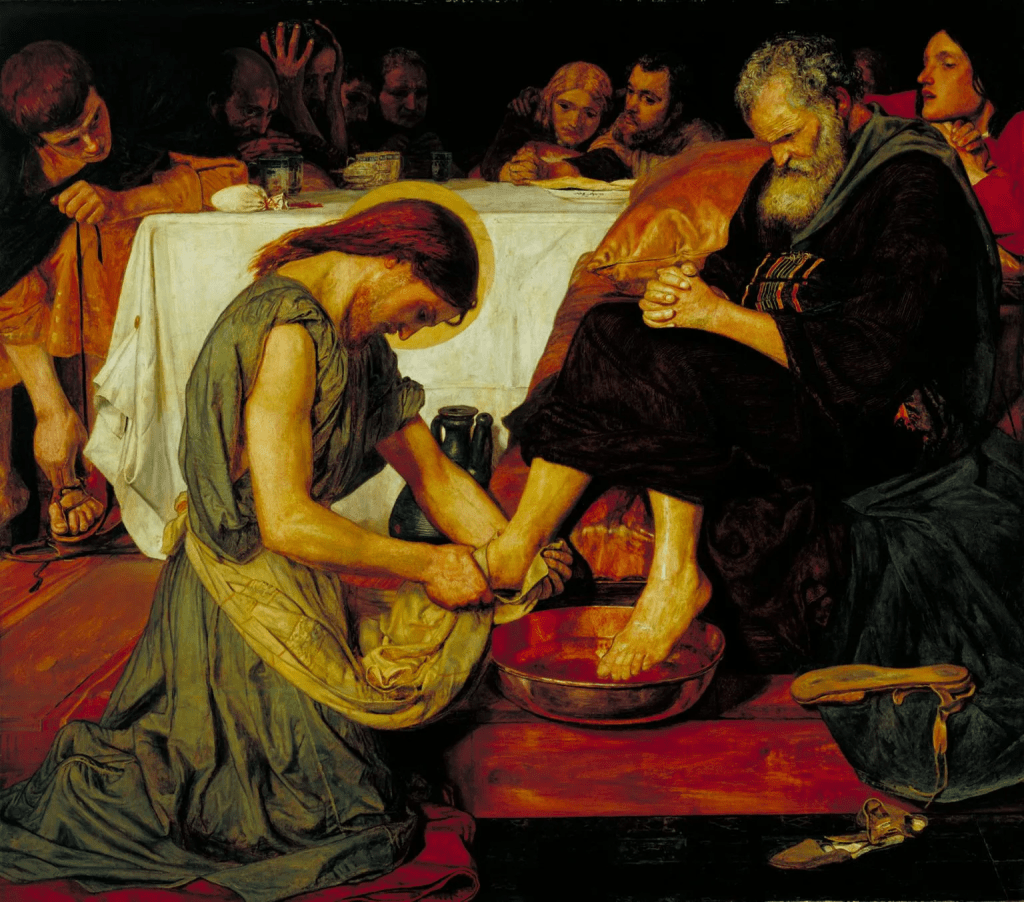
    And then, he kneels.

    The Lord of all creation.
    The one through whom all things were made.

    Kneels.

    And washes feet.

    Dusty, worn, human feet.

    Peter protests, of course.

    Because this is not how power works.

    This is not how God is supposed to be.

    And yet Jesus says:

    “If I, your Lord and Teacher, have washed your feet, you also ought to wash one another’s feet.”

    This is the commandment we remember tonight, the mandatum.

    “Love one another as I have loved you.”

    Not sentiment.
    Not abstraction.
    But embodied, costly, self-giving love.

    In the final part of Gilbert’s journey, she learns to love again, to risk her heart, to receive love without fear.

    But here, tonight, we are taken even further.

    Because this is not just about learning to love.

    This is about being loved first.

    Loved to the end.
    Loved to the cross.
    Loved beyond death itself.

    And then, being sent to love in the same way.

    To kneel.
    To serve.
    To give ourselves for others.

    This is not easy love.

    This is cruciform love.

    The Journey

    Eat. Pray. Love.

    It sounds simple.

    But tonight, we see that it is anything but.

    Because this is not a journey to comfort or self-discovery.

    This is a journey into the heart of God.

    A journey that takes us from the table –
    to the garden –
    to the cross.

    We do not travel to Italy or India or Bali.

    We travel with Christ through Jerusalem.

    Through intimacy and betrayal.
    Through prayer and abandonment.
    Through love poured out to the very end.

    And the invitation is not to observe this journey from a distance.

    It is to enter it.

    To eat.
    To pray.
    To love.

    Again and again.

    Invitation

    So tonight, come to the table.

    Receive what is given.

    Stay in the garden.

    Watch, even if you grow tired.

    And allow yourself to be loved.

    Because this night is not ultimately about what we do.

    It is about what Christ does.

    He feeds us.
    He prays for us.
    He loves us.

    And he invites us; gently, persistently, to follow.

    To become people who eat with gratitude,
    who pray with honesty,
    and who love with courage.

    And as we move now into the silence…

    As the altar is stripped, and the church is laid bare…

    May we not rush away.

    May we remain.

    For this is only the beginning.

    Amen.

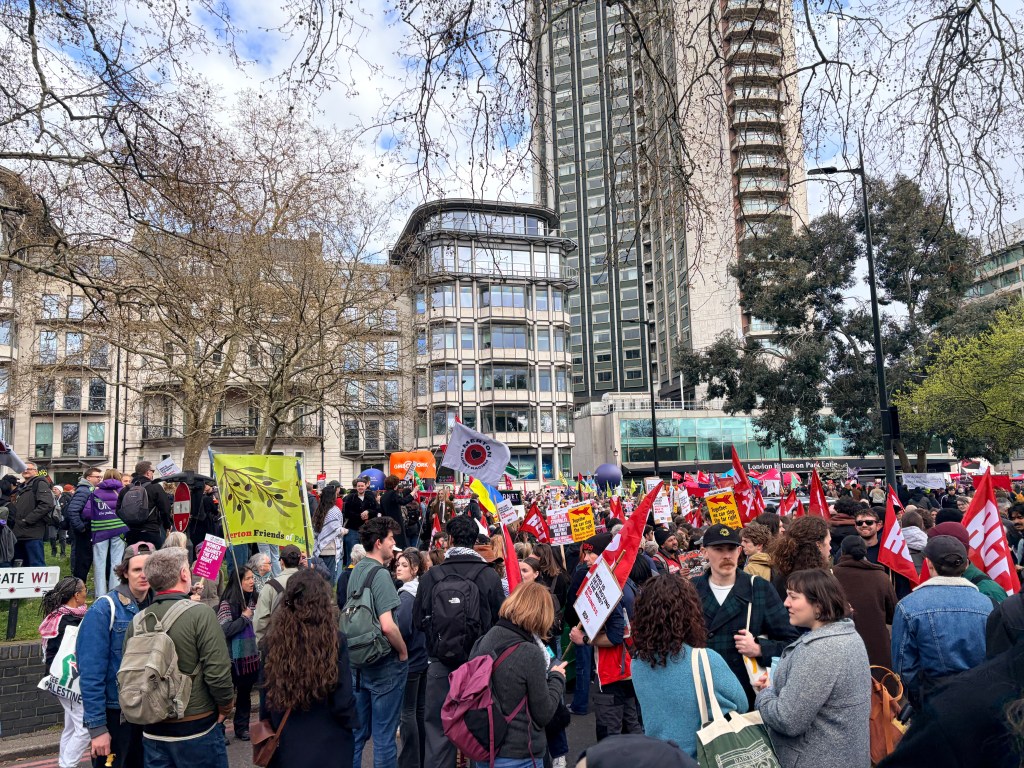
  • Yesterday, I stood in central London with hundreds of thousands of others, alongside folk from my neighbourhood in Stamford Hill.

    Around half a million people gathered to say no to racism. It was powerful. It was hope-filled. And, because there were so many of us, it was long, a happy problem to have. There was something deeply moving about walking together, voices raised, bodies present, choosing to stand for justice.

    It felt, in a way I hadn’t expected, like a threshold moment.

    Because today, the Church begins Holy Week.

    And we begin with a procession.

    On Palm Sunday, we remember Jesus entering Jerusalem on a donkey, met by a crowd full of expectation and energy. They lay down cloaks and branches. They shout their praise: “Hosanna! Blessed is he who comes in the name of the Lord!”

    It is a moment that feels not unlike a march, a gathering of people, a movement through the streets, a shared cry for something better. A hope that God’s kingdom might be breaking in.

    And yet we know how the story turns.

    The same crowd who cry “Hosanna” will, within days, cry “Crucify.”

    Which leaves us with an uncomfortable question:

    What do we do with crowds?

    Because London knows crowds well. Marches are not unusual here. Not long ago, a much smaller march processed through the city with very different intentions, claiming to “unite the kingdom,” but carrying a very different spirit.

    Crowds can be powerful. They can be hopeful. They can also be dangerous.

    Palm Sunday doesn’t ask us to avoid crowds, but it does ask us to examine them. 

    To examine ourselves within them.

    What are we shouting?
    What are we standing for?
    What kind of kingdom are we marching towards?

    The hymn puts it beautifully:

    All glory, laud, and honour
    to thee, Redeemer, King,
    to whom the lips of children
    made sweet hosannas ring.

    But what hosannas are we singing?

    Yesterday, half a million people took to the streets of our capital to say; 

    That justice matters. 

    That dignity matters. 

    That racism has no place in the world we are called to build.

    There was something deeply aligned, I think, with the cry of the Gospel in that.

    Because the kingdom Jesus rides in to proclaim is not built on power or exclusion, but on justice, peace, and mercy.

    And Holy Week will show us the cost of that.

    It will show us what happens when love confronts injustice. 

    When truth stands against power.

    When God refuses to turn away from human suffering.

    The journey from Palm Sunday to the cross is not a change of direction, it is a deepening of it.

    The same Jesus who is welcomed with palms will walk steadily towards the place where justice and mercy meet in the most costly way imaginable.

    So perhaps Palm Sunday invites us not just to wave branches, but to choose our allegiance, and to walk the road.

    Because not every crowd cries the truth.
    Not every march leads to life.
    And not every “Hosanna” is faithful.

    The question is not whether we will join a crowd
    but which kingdom we belong to.

    The kingdom of God is not shaped by popularity, fear, or power.
    It stands, again and again, on the side of justice, of mercy, of truth – no matter the cost.

    And Holy Week shows us exactly where that leads.

    To a table, where love kneels to serve.
    To a cross, where love refuses to turn away.
    To a silence, where hope waits in the dark.

    This is not a change of direction from Palm Sunday,
    it is the deepening of it.

    So if we cry “Hosanna” today,
    we are invited to keep walking.

    To walk into the intimacy of Maundy Thursday.
    To stand in the stark truth of Good Friday.
    To wait in the great silence of Holy Saturday.

    And to discover, in God’s time,
    the life that breaks through on Easter morning.

    So come and walk this week.

    You can walk it in your own home, or in a church.

    But come, not because you must,
    but because Christ walks this path with us.

    Enter into the story.

    A story of justice and mercy,
    of love that does not turn back,
    and of a kingdom that is even now breaking into the world.

  • The Resurrection of Lazarus: Henry Ossawa Tanner

    John 11:1–45 | Psalm 130 | Ezekiel 37:1–14

    I’ve had a rather unusual week.

    I lost my voice with a chest infection that turned into Laryngitis – it is only just beginning to return. And so, this week has been marked by an unexpected companion: silence.

    Proper silence.

    The kind you don’t choose.

    The kind where even whispering makes things worse.

    And if, like me, you are someone who loves to talk… it is not an easy thing to accept.

    But silence, I have discovered again this week, is not just absence.

    It can feel uncomfortable – jarring, even frightening. It can feel like something is missing, like something has gone wrong.

    And yet …

    Silence can also be healing.
    It can be spacious.
    It can be quietly, stubbornly, full of life.

    It made me think of that well-known line from The Sound of Silence
    “People talking without speaking, people hearing without listening.”

    There is a kind of silence that is empty.
    But there is also a silence that is full.
    A silence in which something is happening, even if we cannot yet hear it.

    And that is the kind of silence our readings draw us into today.

    Our readings are filled with the language of death.

    But they are also filled with silence.

    A valley of dry bones.
    A cry from the depths.
    A sealed tomb in Bethany.

    Each one holds a different kind of silence.

    In Ezekiel’s vision, the prophet is taken to a valley scattered with bones – not simply death, but long death. Bones dried out, bleached by time.

    It is a silent place.

    No breath.
    No voice.
    No movement.

    The silence of a people who have lost hope for so long that even lament has faded.

    And into that silence, God speaks:
    “Can these bones live?”

    It feels like a question asked into emptiness.

    And yet – even here – the silence is not the end.

    Because the breath of God begins to move.

    At first, nothing dramatic. No sudden noise. Just the quiet, persistent work of God.

    Bone joining to bone.
    Sinew and flesh forming.
    Breath returning.

    Until the silence of death becomes the silence of awe.

    The psalm gives us another kind of silence.

    “Out of the depths I cry to you, O Lord.”

    This is not the silence of emptiness, but the silence that follows crying out.

    When the words have been spoken.
    When the tears have fallen.
    When there is nothing left to say.

    And so, the psalmist waits.

    “My soul waits for the Lord more than watchmen for the morning.”

    It is a different kind of silence.

    Not dead silence.

    But waiting silence.

    The kind of silence that stands on the edge of hope 
    straining toward the first hint of light.

    And then we come to Bethany.

    To the tomb of Lazarus.

    And here, the silence feels heaviest of all.

    Jesus arrives too late – or so it seems.

    Four days.

    The rituals are done.
    The mourners have gathered and gone.
    The stone is sealed.

    And Martha names what others might avoid:
    “Lord… there is already a stench.”

    Death has done its work.

    And with it comes that deep, uncomfortable silence.

    The silence of finality.
    The silence that says: this is over.

    And yet – into that silence – Jesus speaks.

    “Lazarus, come out.”

    And everything changes.

    Because the silence of the tomb is broken.

    Not by noise for its own sake 
    but by the voice of the one who is life itself.

    And perhaps this is what we begin to see:

    That not all silence is the same.

    There is the silence of death…
    and there is the silence in which God is already at work.

    As we draw close to Holy Week and as we conclude our series of journeying through Keeping Holy Time, we turn toward a day we rarely speak about.

    Not Good Friday.
    Not Easter morning.

    But the day in between.

    Holy Saturday.

    And Holy Saturday is a day of silence.

    Not the dramatic silence of Good Friday, where grief is raw and visible.
    Not the joyful sound of Easter morning, where alleluias return.

    But a deeper silence.

    A quieter one.

    The silence of waiting.

    If you have ever sat in an empty church, you may know something of it.

    Not the gentle stillness when others are praying nearby.

    But the kind of stillness when the space is completely empty.

    The altar stripped.
    The candles extinguished.
    The air heavy.

    It is not just peaceful.

    It can feel like absence.

    Like something, or someone, is missing.

    And that is the silence Holy Saturday invites us to enter.

    The silence where Christ is no longer visibly present.

    The one who spoke, who healed, who called Lazarus from the tomb…

    is now silent.

    Laid in the earth.

    And yet, this is where the Church dares to say something extraordinary.

    We don’t say it often, but if we confess it in the Apostles’ Creed when we say of Christ:

    “He descended to the dead.”

    Or, as it was once more starkly said in Book of Common Prayer:

    “He descended into hell.”

    It is a strange line.

    Because the Gospels give us no words here.

    Only silence.

    But the early Church listened differently to that silence.

    They heard it not as emptiness

    but as movement.

    Not as absence

    but as presence hidden.

    Because what if Holy Saturday is not the silence of nothing happening…

    but the silence of something happening too deep for us to see?

    The silence of Christ entering even the furthest reaches of death.

    The silence of God going to the places we think are beyond reach.

    The silence where the gates of death begin, quietly, to give way.

    In the ancient imagination of the Church, this moment was pictured with astonishing hope.

    Christ stands in the darkness.

    Not defeated, but victorious.

    The doors of death shattered beneath his feet.

    And Christ reaches down,

    to Adam, to Eve

    to all humanity

    and begins to lift them up.

    It is the same pattern we have already seen.

    The silence of the valley…
    becoming the breath of life.

    The silence after the cry…
    becoming the waiting for morning.

    The silence of the tomb…
    broken by the voice of Christ.

    And now, the silence of Holy Saturday…

    becoming the hidden work of resurrection.

    Because so much of our lives is lived here.

    In this in-between.

    Between prayer and answer.
    Between loss and healing.
    Between grief and hope.

    Between Good Friday… and Easter morning.

    And it can feel like silence.

    Like nothing is happening.

    Like God is absent.

    But Holy Saturday gently, quietly, insists:

    This is not the silence of death alone.

    This may be the silence of God at work.

    Deep. Hidden. Unseen.

    And so, the Church waits.

    Like the psalmist, watching for the morning.

    Like Ezekiel, standing in the valley.

    Like Martha, standing at the tomb.

    Waiting.

    Trusting.

    Listening.

    And then, when the time comes, the silence will break.

    Not with chaos.

    But with light.

    A flame kindled in the darkness.

    A single voice singing.

    A whisper that grows into song:

    Alleluia.

    For now, though 

    we keep holy time.

    We honour the silence.

    We do not rush it.

    Because even here…

    even now…

    God is at work. Amen

  • Luke 2:33–35; 2 Corinthians 1:3–7

    Desolation – that is what I have always felt at the foot of the cross.
    Utter and complete desolation … and yet, somehow, deep gratitude.

    As a young person the feeling was almost overwhelming. Good Friday breaks me. It always has.

    Over the years I have tried to understand why. Why does this day feel so physically and emotionally draining? I think part of it for me is that as my relationship with Christ has deepened, as he became not only my Saviour and Lord, but also my companion and friend, I feel the grief of the cross more intensely as the intimacy of my own relationship deepens.

    And then life adds other layers.

    When I became a mother in my early twenties, the story of Good Friday changed again for me. I began to see the cross through the eyes of Mary, the mother who stands watching her son die. The grief of that moment became almost unbearable to imagine.

    I wonder how and what you feel on Good Friday?

    So, when I was recently re-reading the account of the fourth-century pilgrim Egeria, whose writings we have been exploring in this series as we prepare for Holy week, something she wrote stopped me in my tracks. She describes the crowds gathered to hear the Passion story in Jerusalem, and she says this:

    “It is impressive to see the way all the people are moved by these readings, and how they mourn. You could hardly believe how every single one of them weeps during those three hours, old and young alike, because of what the Lord suffered.”

    Sixteen centuries ago, Christians were doing exactly what we still do today: standing before the cross and allowing their hearts to break open.

    Because Good Friday brings us face to face with two realities at the same time:

    the cruelty of Christ’s death,
    and the astonishing love of God revealed within it.

    Today on our journey of Keeping Holy Time as we prepare for Holy Week, the life of the Church brings us to a very particular place.

    Not a place of triumph.
    Not a place of celebration.

    But to the foot of the cross.

    Good Friday now just a few weeks away invites us to stand there.

    To stand with the disciples who cannot quite understand what is happening.
    To stand with the crowds watching in grief and confusion.
    And to stand with Mary, the mother of Jesus, as Simeon’s prophecy is fulfilled:

    A sword will pierce your own soul too.

    On this fourth Sunday in Lent, also Mothering Sunday, we glimpse something of that sorrow, a mother standing beneath the suffering of the child she once held in her arms.

    Pieta – Michelangelo

    And as we stand there, we continue asking the question we have been exploring throughout Lent:

    Why do we do what we do?

    Why does the Church keep this day the way that it does?

    Across the world the shape of Good Friday worship can look quite different.

    Here at St Andrew’s, we keep the day with what the Church calls The Liturgy of the Day.

    It is a simple but powerful service centred on three things:

    the telling of the Passion story,
    the prayers of the Church for the world,
    and the veneration of the cross.

    During this part of the service, the cross is brought before us, and people are invited (if they wish) to come forward and honour it.

    Some bow.
    Some kneel.
    Some touch or kiss the cross.

    We do not worship the wood itself.

    Rather, we honour what it represents: the place where Christ’s self-giving love for the world was revealed.

    For some people that gesture feels natural.
    For others it can feel unfamiliar.

    Why would we do such a thing?

    To understand that, it helps to look back to the earliest descriptions we have of Good Friday worship.

    We know from Egeria in the fourth century that on Good Friday the whole city seemed to move through the story of the Passion together.

    Through the night people walked from place to place:

    from the Mount of Olives,
    to Gethsemane,
    through the city gates,
    and finally to Golgotha.

    Egeria writes of pilgrims exhausted from fasting and keeping vigil.
    Crowds so moved by the story of Jesus’ suffering that their weeping filled the city.

    Later that morning something remarkable happened.

    A table was set before the bishop, and brought forward was a reliquary believed to contain the wood of the cross.

    Then, one by one, the people came forward.

    They bowed.
    They touched.
    They kissed the wood.

    Not as an object of worship.

    But as a sign.

    A sign that this is where salvation happened.

    So, when we venerate the cross on Good Friday, we are joining a practice that stretches back at least sixteen centuries.

    But even more than that, we are doing something deeply human.

    Because Good Friday is not simply something we think about.

    It is something we enter with our whole selves.

    Christian faith has always insisted that our bodies matter.

    God did not redeem us from a distance.
    God came among us in flesh.

    And the story of Good Friday is not abstract theology.

    It is painfully physical.

    Hands nailed.
    Feet pierced.
    Breath failing.
    Blood poured out.

    Because Good Friday brings us face-to-face with grief.

    Most of us know something of that grief.

    The grief of bereavement.
    The grief of broken relationships.
    The grief of the world as it is.

    Sometimes we even carry grief for the places within ourselves where we fall short.

    Good Friday does not ask us to hide any of that.

    Instead, it invites us to bring it all to the cross, and lay it down.

    To stand there honestly.

    To allow the suffering of Christ to meet the suffering of the world.

    Even now, if I am honest, Good Friday still undoes me.

    The tears still come.

    A strange mixture of grief and gratitude.

    Grief at the suffering of Christ.

    Gratitude that somehow, mysteriously, this act of love is for us.

    Perhaps that is why the Church does not try to explain the cross away.

    Good Friday is not a puzzle to be solved.

    It is a mystery to be entered.

    In St Mark’s Gospel, as Jesus breathes his last upon the cross, a Roman centurion stands watching.

    A soldier of the empire.

    And seeing how Jesus died, he says:

    “Truly this man was God’s Son.”

    Not a disciple.
    Not a priest.

    But a soldier.

    Standing at the foot of the cross.

    Looking.

    And finally seeing.

    That is what Good Friday asks of us too.

    Simply to stand there.

    To look.

    And to allow the mystery of that love to break open our hearts.

    Because on Good Friday we live in a strange in-between space.

    We know Easter morning is coming.

    But we do not rush ahead.

    We stay with the cross.

    We allow the weight of it to rest upon us.

    And perhaps, like those early Christians Egeria described, we simply allow ourselves to be moved.

    To weep.
    To pray.
    To wait.

    So, when the moment comes and you are invited to come forward to venerate the cross on Good Friday, do not worry about doing it the “right” way.

    Some will kneel.
    Some will bow.
    Some may simply stand quietly.

    All of it is prayer.

    All of it is a way of saying:

    Here is the love of God.
    Here is the cost of that love.
    Here is the place where our salvation is found.

    So as we prepare to keep holy time.

    we stand.
    we behold.
    we wait.

    Amen.

  • Lectionary Readings for Lent 3: Exodus 17: 1-7 | Psalm 95 | John 4: 5-42.

    As some of you may know, I have come to London via Wales, via Cardiff. Cardiff has been woven into my life since my early twenties, and that stitching began when I went there to study singing at the Royal Welsh College of Music and Drama in 1999.

    At college, we performed in many wonderful places; St David’s Hall, later the Millennium Centre, but the place we loved most was Llandaff Cathedral.

    Llandaff is ancient and wounded. Medieval in its foundations yet heavily bombed in the Second World War. Much of it had to be rebuilt. And as part of that rebuilding, the sculptor Jacob Epstein was commissioned to create something that would speak of devastation and hope.

    What he created was extraordinary and controversial. A vast 16-foot Christ in Majesty, suspended above the nave on a great concrete arch. Concrete against ancient stone. It is still something of a Marmite sculpture.

    But as performers, we sat directly beneath it. And from where we sat, you could not see Christ’s face.

    All you could see were his hands.

    And his feet.

    It fascinated me.

    Nearly twenty years later, I found myself kneeling beneath those same hands and feet. First, as a sub-deacon on Maundy Thursday during my training. Later, as I was ordained deacon. And then priest.

    Those hands and feet I once gazed upon now seemed to gaze upon me.

    And that image has never left me.

    As Teresa of Ávila writes, “Christ has no body now on earth but yours. No hands, no feet but yours.”

    But what does that mean?

    What does it mean as we arrive, in this journey of Keeping Holy Time, at Maundy Thursday – a day that is, at its heart deeply embodied, and all about hands and feet?

    Because on that night:

    Hands take bread.
    Hands bless.
    Hands break.
    Hands give.

    And then those same hands tie a towel, kneel down, and wash feet.

    Maundy Thursday is not abstract theology.

    It is hands and feet.

    Jacob Epstein – Christ In Majesty – Llandaff Cathedral

    Today our readings from the lectionary speak of bodies.

    In Exodus, the people thirst in the wilderness. Their bodies ache. Their mouths are dry. They cry out, “Is the Lord among us or not?” And water comes from struck rock.

    In the psalm, we are invited to bow down to bend our bodies in worship.

    In John’s Gospel, a woman comes to a well at midday. Jesus says to her, “Give me a drink.” What begins as physical thirst becomes something deeper, living water, welling up to eternal life.

    Our physical bodies and the deep human longing to be sustained, to know that God is truly among us.

    And Maundy Thursday is where that longing becomes tangible.

    Because on that night, Jesus does not give a theory.

    He gives something you can hold.

    He places bread into human hands and says, “Do this in remembrance of me.”

    He pours wine and says, “This is my blood.”

    Before we can wash anyone’s feet, before we can speak of love, our hands must first open in dependence. Maundy Thursday teaches us that the Church begins not with our activity, but with receiving Christ.

    Because the Last Supper was not an abstract ritual in a vacuum. It was a meal among friends. Bread passed hand to hand. Cups shared. Feet dusty from walking.

    The woman at the well came with an empty jar and left overflowing.

    On Maundy Thursday, we come with empty hands and Christ fills them.

    But the night does not end at the table.

    John’s Gospel that we hear at many churches on Maundy Thursday does not give us the familiar words over bread and wine. Instead, it gives us a basin and a towel.

    Jesus rises from supper.
    He removes his outer garment.
    He kneels.

    The hands that broke bread now wash feet.

    Dusty feet.
    Tired feet.
    Vulnerable feet.

    Peter recoils – and perhaps we do too. Bread feels safe. But this is personal. This is exposing. This asks something of us.

    “Unless I wash you,” Jesus says, “you have no share with me.”

    Maundy Thursday is not first about what we do for Jesus.

    It is about what he does for us.

    He kneels before our dust.
    He touches what we would rather keep hidden.
    He serves without hesitation.

    And only then comes the commandment – the mandatum:

    “Love one another as I have loved you.”

    Not as you find convenient.
    Not as you feel inclined.
    As I have loved you.

    Love with hands.
    Love at ground level.
    Love that feeds and washes and stays.

    And then, slowly, the mood changes.

    After the meal, after the washing, after the hymn, they go out into the night.

    The Church, from its earliest centuries, has understood this as a night not to rush. A night to linger in the story. A night when the atmosphere shifts.

    We strip the altar.

    We remove the cloths as it were of the church.
    We take away the vessels.
    We leave the sanctuary bare.

    The hands that received bread now remove it.
    The hands that shared fellowship now prepare the church for absence.

    It is a physical act of transition.

    The warmth of the meal gives way to the starkness of Good Friday.

    The church is made ready for the day when Christ will hang stripped and exposed.

    Maundy Thursday is the hinge between companionship and abandonment.

    It is the night the Church learns whether it will stay not necessarily in prolonged silence, but in faithful participation.

    To stay in the story.
    To stay with the discomfort.
    To stay when the atmosphere darkens.

    In Exodus, the people wondered if God was truly among them.
    In John, the woman discovered that God was standing in front of her, asking for a drink.
    On Maundy Thursday, God kneels before us.
    And by Good Friday, he will say, “I thirst.”

    The needs and experiences of our bodies runs both ways.

    Psalm 95 urges us, “Today, if you hear his voice, do not harden your hearts.”

    Maundy Thursday is a softening night.

    It softens our hands – from clenched to open.
    It softens our pride – from standing to kneeling.
    It softens our fear – from stepping back to stepping closer.

    Because this is not a week for spectators.

    This deep embodiment.

    To gather.
    To eat together.
    To receive.
    To kneel.
    To watch the altar stripped.
    To return on Friday.
    To wait on Saturday.

    Maundy Thursday teaches us so much about being the Body of Christ.

    Hands that receive bread.
    Hands that wash feet.
    Hands that strip the altar.
    Feet that walk into the night together.

    Christ has no body now on earth but ours.

    No hands but ours to break bread.
    No hands but ours to wash.
    No hands but ours to prepare the place of waiting.

    No feet but ours to follow him into what comes next.

    So, as we continue to prepare for the great week of Holy Week, I encourage us to ask ourselves gently:

    Where will we be in the story?

    At the table?
    With the towel?
    In the sanctuary as the altar is laid bare?

    For the hands that broke bread,
    the hands that washed feet,
    are now given to us the Church 
    that Christ may still serve the world through us. 

    Amen.

  • Palm Sunday Procession St. James Anglican Church, Vancouver, 2014

    This Lent, here at St. Andrew’s and in accross our partnership, we continue our series Keeping Holy Time, where we have been exploring why do we do what we do in Lent and holy week, and by engaging with it more deeply ahead of time we can be more able to enter into the mystery and joy of this most Holy time.

    And this week we are going to unpack Palm Sunday:

    Wondering together

    Why palms?
    Why procession?
    Why this strange collision of joy and sorrow that we call Palm Sunday?

    Now our lectionary readings today whisper something of it, but clearly not directly. 

    (Here are the lectionary readings in you want to read them this week: Genesis 12:1–4a | Psalm 121 | John 3:1–17)

    In Genesis, Abram is called to leave – to step into a journey he does not yet understand. Here we find parallels particularly for the disciples as they find a donkey and go into Jerusalem with Jesus.

    And in John’s Gospel, Jesus tells Nicodemus that God so loves the world that he gives himself for it. 

    These encourage us to think about

    Journey.
    Self-giving love.

    And Palm Sunday gathers all of those themes.

    I wonder what you think and feel about Palm Sunday: processions, shouts of Hosanna, welcoming a king, only to then return to church, where we read for the first time in Holy Week the Passion reading of Our Lord Jesus Christ.

    For almost ten years as a family we lived and worked in Vancouver, in an area called the Downtown Eastside.

    It was a remarkable place – and a tough place.
    At that time it was the poorest postcode in Canada.
    With the highest open drug use.
    Profound beauty and profound pain sitting side by side.

    I learnt more there about myself, about humanity, and about God than almost anywhere else I have lived.

    The church where we served stood dominant in stature and beauty in the midst of that complicated community. A bastion of inclusive Anglo-Catholic worship that drew people from across the city and also the local community.

    Those involved in the murky world of drugs, worshipped alongside high court judges, sex workers knelt at the altar with professors of English. It was raw and also a little otherworldly. But the one thing you absolutely could not do there was pretend.

    When people are living so close to the edge, inauthenticity can be spotted a mile off -and it will be called out. It can be humbling.

    You had to be real.

    And whenever I picture Christ on a donkey, I often think – the folk of the Downtown Eastside would have known him.

    Because it was authentic.
    Humble.
    Exposed.
    A little absurd, perhaps.
    But real.

    Every Palm Sunday, we would process through that neighbourhood – a quirky carnival band all dressed in white led us, incense swung and billowed as we walked, colour and beauty of the vestments in all its Anglo-Catholic glory. It was carnival and chaos and beauty and faith woven together.

    People would stop.
    Some would laugh.
    Some would join.
    Some would simply watch.

    And then we would return to the church.
    The doors would close.
    The atmosphere would shift.

    Holy Week had begun.

    The Hosannas would fade.
    And like we do here at St Andrew’s – and in churches throughout the world – we would stand and listen to the Passion Gospel.

    Palm Sunday is a day of extremes.

    And that is not accidental.

    Palm Sunday Procession St. James Anglican Church, Vancouver, 2014

    In the fourth century, a woman, most likely a nun named Egeria, travelled to Jerusalem. She left us a diary – not a theology book, but a travel journal – describing how Holy Week was kept there all those years ago.

    She calls it “The Great Week.” (This is still what Orthodox Christians call it.)

    And what she describes is astonishing.

    The people gathered on the Mount of Olives.
    They listened to Scripture.
    They sang psalms.
    Children were carried on shoulders.
    Elderly people were accommodated.
    And then, at five o’clock, the Gospel of the children waving branches was read.

    And they began to walk.

    Down the Mount of Olives.
    Through the city.
    All the way to the Anastasis – the place of Resurrection.

    They did not simply hear the story.

    They walked it.

    They sang it.

    They inhabited it.

    Palm Sunday was not an idea.
    It was an embodied drama.

    Holy Week was never meant to be rushed.

    It was meant to be entered.

    And what is remarkable is that what happened in 4th century is incredibly similar to what we know do in 2026 here in London and across the world. The re-living, re-loving of the story continues.

    And that matters.

    Because when Jesus rides into Jerusalem, he is not staging a sentimental parade.

    He is enacting Zechariah’s prophecy – the king who comes riding on a colt.

    But not a war horse.

    A king of peace.

    A king whose victory will not come by the sword.

    A king whose throne will be a cross.

    The crowd sings Psalm 118:

    “Blessed is he who comes in the name of the Lord!”

    But that psalm is not just about welcome.

    It is about sacrifice.

    “Bind the festal procession with branches, up to the horns of the altar.”

    The king who enters the city is going up to the altar.

    And the offering will be himself.

    Palm Sunday is not naïve joy.

    It is the beginning of surrender.

    And soon we will arrive at Palm Sunday

    We will wave palms.
    We will sing Hosanna.
    We will perhaps smile.

    And then we will stand and hear betrayal.
    Violence.
    Abandonment.
    A cross.

    Why do we do that?

    Because faith that only sings Hosanna will not survive Good Friday.

    Because Lent is a journey into the self-giving love of God.

    Palm Sunday tells the truth:

    The same crowd can shout “Hosanna!” and “Crucify!”

    The human heart is capable of both and that focuses our minds in the deeply humbling and painful truth of life.

    And Christ rides toward us anyway.

    Humble.
    Exposed.
    Real.

    Palm Sunday Procession St. James Anglican Church, Vancouver, 2014

    In the lectionary this week, we hear in Genesis the call for Abram to step into a journey.

    Palm Sunday calls us to step into one too.

    That we too, may enter into the Great Week.

    The Church gives us these days of Holy Week and Easter not so that we can observe them from a distance, but so that we can enter them.

    To come on Maundy Thursday and kneel.
    To keep watch at the altar of repose.
    To stand at the foot of the cross on Good Friday.
    To sit in the silence of Holy Saturday.
    To come to the fire of Easter.

    Egeria’s community walked the story over 1600 years ago

    We are invited to do the same.

    Because Holy Week is not something we consume.

    It is something that consumes us.

    So, in a few short weeks we too will wave our palms, let us not rush.

    Let us not treat this as a liturgical costume change.

    Let us allow the joy and the sorrow to sit side by side.

    Carnival and chaos and beauty and faith.

    Let us be real.

    Because Christ is.

    As you journey through Lent, let encourage one another not to stand at a distance.

    Enter the drama.

    Walk the story.

    Keep Holy Time. 

  • Genesis 2:15–17; 3:1–7 | Psalm 32 | Matthew 4:1–11


    Keeping Holy Time

    This Lent at St. Andrews N16, and in our partnership with St. Mary’s N16, we are journeying together through the theme “Keeping Holy Time.” Week by week, we are exploring the great days of this season – from Ash Wednesday and Lent itself, through Palm Sunday, Maundy Thursday, Good Friday, and Holy Saturday.

    To keep holy time is to allow the story of Christ’s passion and resurrection to shape us slowly and prayerfully. The Church gives us this season and these days not to rush through, but to inhabit – to repent, to watch, to wait, and ultimately to hope. As we return to these sacred moments together, may they form us more deeply in the life and love of Christ.

    This week we begin our Lent journey together – alongside our study group – Keeping Holy Time exploring the season of Lent and Ash Wednesday.

    And perhaps the simplest question is this:

    Why?

    Why keep a holy Lent?
    Why ashes?
    Why fasting?
    Why this annual return to wilderness?

    Because Lent can so easily become thin.

    Either a religious self-improvement programme –
    “New Year, but holier.”

    Or a manageable sacrifice –
    “I’ll give something up,”
    and quietly count the days until Easter.

    But the Church is inviting us into something far deeper.

    She is inviting us to step back into the story.

    The Garden

    Genesis takes us to the beginning.

    A garden.

    A place of abundance.
    Of beauty.
    Of intimacy with God.

    Adam and Eve are given everything they need.

    Only one boundary.
    One tree.

    And the serpent’s voice is subtle:

    “Did God really say, you shall not east of ?”

    The first temptation is not about fruit.

    It is about trust.

    And notice how the fruit is described:

    Good for food.
    A delight to the eyes.
    Desirable to make one wise.

    Appetite.
    Possession.
    Pride.

    And when they take it – when they grasp – something shifts.

    “Their eyes were opened…
    and they hid.”

    Sin leads to concealment.

    They sew fig leaves.
    They withdraw.
    They blame.

    The first human instinct after failure is not confession.

    It is hiding. And that is hard to hear and to accept.

    Psalm 32 tells us that instinct has never left us.

    “While I kept silence, my body wasted away.”

    Silence.
    Covering.
    Concealment.

    We manage our image.
    We curate ourselves.
    We keep certain things tucked away.

    And Lent begins by interrupting that.

    Ash Wednesday: Truth Without Drama

    On Wednesday, we stood in a very simple liturgy.

    No Gloria.
    No flourish.
    Just Psalm 51.
    Just Joel’s cry: “Return to me.”
    Just the stark words: “Remember that you are dust.”

    In fact some of us noted at the end that we felt it was deeply meditative.

    Lent’s liturgy is stripped back.

    Purple.
    Plain.
    Scripture-heavy.

    And did you notice how much of it draws from the Old Testament?

    Joel.
    The Psalms.
    Genesis.
    The prophets.

    It is as if the Church takes us by the hand and says:

    Before we rush to resurrection,
    remember the story.

    Ashes, as the tradition reminds us, are deeply biblical.

    They are a sign of mortality – dust to dust.
    They are a sign of repentance – like Job.
    They are a sign of intercession – like Daniel and Esther.

    They are not theatrical.

    They are truthful.

    They say:

    I am mortal.
    I have fallen.
    I need mercy.

    But here is the quiet wisdom of the Church.

    Ash Wednesday is public.

    But Lent is hidden.

    Jesus tells us:

    When you fast.
    When you pray.
    When you give.

    Not if.

    And not to be seen.

    The ashes mark us once.
    The deeper work happens in secret.

    “Rend your hearts, not your garments.”

    Lent is not about spiritual performance.

    It is about interior truth.

    The Desert: A Second Beginning

    Then today this first Sunday in Lent we are taken somewhere else.

    From garden to desert.

    Matthew tells us:

    Jesus is led by the Spirit into the wilderness.

    He is not lost.

    He is led.

    The desert is not punishment.

    It is preparation.

    And there, in the wilderness, the same three distortions appear again.

    “Turn these stones to bread.”
    Appetite.

    “All the kingdoms of the world will be yours.”
    Possession.

    “Throw yourself down.”
    Pride.

    The same pattern as Eden.

    But this time something different happens.

    Jesus does not grasp.
    He does not justify.
    He does not hide.

    He answers with Scripture.

    Notice that.

    Not argument.
    Not bravado.

    Scripture.

    “Man shall not live by bread alone.”
    “You shall worship the Lord your God.”
    “You shall not put the Lord your God to the test.”

    In Genesis, humanity reaches for autonomy.

    Temptation in the Wilderness – Briton Riviere

    In Matthew, Christ leans into obedience.

    In the garden, humanity hides.

    In the desert, Christ stands.

    The desert becomes a kind of second beginning.

    The Wilderness We Know

    And the wilderness is not always dramatic.

    It doesn’t always look like sand and stones.

    Sometimes it looks like exhaustion and overwhelm.

    I know in my own life, when I have been stretched thin personally, professionally, or spiritually, that I feel I need to rely on myself to get through.  

    These are seasons when I realised how quickly I reached for something to steady myself. Achievement. Approval. Control. 

    And that is wilderness.

    It is the place where we discover what we lean on.

    What we reach for when we are hungry, not just for food,  but for reassurance.

    And Lent invites us there.

    Not to shame us.

    But to show us what is underneath and what needs work.

    What Lent Is For

    So, what is the purpose of keeping a holy Lent?

    It is not self-denial for its own sake.

    It is re-ordering love.

    Genesis shows us disordered love.
    Psalm 32 shows us the ache of concealment.
    Matthew 4 shows us another way.

    Fasting loosens the grip of appetite.
    Almsgiving loosens the grip of possession.
    Prayer loosens the grip of pride.

    Not because these things are evil.

    But because they easily become ultimate.

    And when they become ultimate, we hide.

    But listen again to Psalm 32:

    “I acknowledged my sin to you…
    and you forgave.”

    The psalm moves from concealment to joy.

    “Happy are those whose transgression is forgiven.”

    Lent is not about rehearsing how bad we are.

    It is about discovering how freeing honesty can be.

    The ashes tell the truth.

    The desert teaches trust.

    The psalm sings forgiveness.

    Keeping Holy Time

    This is what we mean by Keeping Holy Time.

    We are not just marking days on a calendar.

    We are stepping into the deep scriptural story.

    The Church slows us down.

    Removes the Gloria.

    Let’s silence breathe.

    Fills our ears with prophets and psalms.

    And gently asks:

    Will you stop hiding?
    Will you trust me in the wilderness?
    Will you let me re-order what you love?

    Because without intentional time, we drift.

    Lent is choosing not to drift.

    Choosing to walk from garden to desert.

    Choosing to move from concealment to confession.

    Choosing to stand with Christ when temptation whispers.

    And discovering that the God who walked in the garden at the beginning
    still walks towards us now.

    Not to condemn.

    But to clothe.

    Not to shame.

    But to restore.

    And so, this first Sunday of Lent, just beyond the ashes, we hear again the invitation:

    Return to me.

    Trust me in hunger.

    Trust me in testing.

    Trust me in mortality.

    And discover that the desert is not the end of the story.

    It is the place where obedience grows.

  • “Create in me a clean heart, O God, and renew a right spirit within me.”

    Psalm 51 | Matthew 6:1–6, 16–21

    I wonder if someone has already asked you today what you are giving up for Lent?

    Chocolate is usually first.
    Then alcohol.
    Biscuits.
    Social media.

    And none of those are bad things.

    But Lent can begin to sound like a religious version of “New Year, New Me.”
    A reset.
    A detox.
    A slightly spiritualised self-improvement plan.

    And yet tonight – as ashes are placed on our foreheads – the Church invites us somewhere much deeper than self-improvement.

    Not “How can I be better?”
    But “How can I return?”

    Because that is the language of Lent.

    Through the prophet Joel, God says:
    Return to me with all your heart.
    Not polish yourself up.
    Not prove your seriousness.
    Return.

    And Psalm 51 gives us the prayer for how that return happens:
    Create in me a clean heart, O God, and renew a right spirit within me.

    Not: “I will fix myself.”
    Not: “I will try harder.”
    But: Create in me.

    Which means Lent is not about tinkering at the edges of our habits.
    It is about allowing God to meet us at depth. We cannot do this without God.

    Why ashes?

    The practice of ashes is ancient – far older than Christianity.

    In the Old Testament, ashes were worn in moments of grief, repentance, and desperate prayer.
    Job repented in dust and ashes.
    Daniel fasted with sackcloth and ashes as he interceded for his people.
    The people of Nineveh covered themselves in ashes when they turned back to God.
    Even Queen Esther, facing the possible destruction of her people, laid aside her royal splendour and covered herself in ashes as she prayed.

    Ashes mean three things.

    They mean mortality –
    “You are dust, and to dust you shall return.”

    They mean repentance –
    an outward sign of an inward turning.

    And they mean intercession –
    a people crying out together, “Lord, have mercy.”

    So, when we receive ashes tonight, we step into something profoundly biblical.
    This is not theatre.
    It is memory.
    It is honesty.
    It is solidarity.

    And yes – some people point out that Jesus tells us in Matthew 6 not to parade our fasting in public.

    But notice something subtle:
    Jesus does not say “Do not fast.”
    He says, “When you fast…”

    He assumes his disciples will fast.
    He assumes we will pray.
    He assumes we will give.

    The question is not if, but how.

    Ash Wednesday is a corporate act – like the great public fasts of Israel.
    But Lent itself becomes quieter.
    More hidden.
    More interior.

    Jesus draws our attention to the secret place –
    the room with the door closed,
    the prayer no one else hears,
    the generosity no one else sees.

    Because the heart of Lent is not display.

    It is relationship.

    What is Lent actually for?

    The Church gives us forty days – not including Sundays – echoing Jesus’ forty days in the wilderness.

    Forty days in which Jesus faced the deepest human temptations:
    the temptation to comfort,
    the temptation to power,
    the temptation to prove himself.

    And instead of grasping,
    he trusted.

    Lent is not punishment.
    It is training in trust.

    Through prayer, fasting, and generosity, we loosen our grip –
    on comfort,
    on control,
    on image.

    And in doing so, we create space for God.

    But here is where I want to be particularly gentle tonight.

    The work of Lent is not only about chocolate or coffee.
    For many of us, the deeper work is interior.

    The stories we tell ourselves about who we are.
    The self-criticism that never quite quietens.
    The unresolved grief.
    The exhaustion we carry.

    Psalm 51 does not say, “Make yourself pure.”
    It says, “Create in me.”

    There is humility in that prayer.
    And relief.

    Because perhaps the most radical thing Lent invites is not harsher discipline –
    but deeper honesty.

    Not indulgence.
    But kindness.

    Not self-absorption.
    But attentiveness.

    Sometimes the truest fast is fasting from self-contempt.
    Sometimes the most powerful almsgiving is generosity toward someone we have quietly resented.
    Sometimes the hardest prayer is simply sitting still long enough to let God love us.

    As a parish

    This year, as a community, here at St. Andrew’s will journey intentionally through Lent toward Holy Week in our sermons each Sunday we will think more deeply about why we do what we do in Lent and Holy Week.

    Ash Wednesday and Lent

    Palm Sunday.
    Maundy Thursday.
    Good Friday.
    Holy Saturday.

    These are not services we attend merely to remember what happened once.

    They are days we enter.
    Liturgies that shape us.
    Mysteries that form us.

    If you are able, make room for as much of the journey as your life allows.
    Not out of obligation,
    but out of desire.

    Because when we walk the path slowly, Easter ceases to be an idea and becomes an encounter.

    And tonight?

    Tonight, we come forward to receive ashes.

    Not to be shamed.
    But to be named.

    Dust.
    Yes.

    But also beloved.

    The ashes mark our mortality –
    but they are traced in the shape of a cross.

    Mortality held within mercy.
    Dust held within love.

    And so, we begin.

    Not with grand declarations.
    Not with spiritual bravado.

    But with a prayer whispered honestly:

    Create in me a clean heart, O God.
    Renew a right spirit within me.

    Return us, Lord –
    not to performance,
    But to relationship.

    Not to self-improvement,
    but to communion and community.

    Not to fear,
    but to love.

    Amen.

  • For use at home, at work, or wherever you are

    You may wish to light a candle or find a place to be still and quiet.

    The Sign of the Cross

    In the name of the Father,
    and of the Son,
    and of the Holy Spirit.
    Amen.

    A Beginning

    Grace, mercy and peace
    from God our Father
    and the Lord Jesus Christ
    be with me here.
    Amen.

    An Invitation

    Christians have long kept Lent
    as a season of turning and returning,
    a time to remember our mortality,
    to repent of sin, and to prepare our hearts for Easter.

    Today, even here, in my kitchen, at my desk, by a hospital bed,
    on a train,
    I join that great turning.

    Lord, give me grace
    to keep a holy Lent.

    Scripture

    You may read slowly:

    Joel 2:12–13

    “Return to me with all your heart,
    with fasting, with weeping, and with mourning;
    rend your hearts and not your clothing.
    Return to the Lord your God,
    for he is gracious and merciful,
    slow to anger, and abounding in steadfast love.”

    Pause.

    And/or pray:

    Psalm 51 (short form)

    Have mercy on me, O God,
    according to your steadfast love.

    Create in me a clean heart, O God,
    and renew a right spirit within me.

    Cast me not away from your presence,
    and take not your Holy Spirit from me.

    Restore to me the joy of your salvation.
    Amen.

    Remembering the Ashes

    You may want to simply trace the sign of the cross on your palms.

    As you say:

    I Remember that I am dust,
    And to dust I shall return.

    I turn away from sin
    And I am faithful to Christ.

    Pause.

    A Prayer of Returning to God

    Lord God,
    you created me from dust
    and breathe your Spirit into me.

    I confess that I have not loved you
    with my whole heart.

    I have been distracted,
    impatient,
    self-protective,
    fearful.

    I have clung to what does not give life.

    Forgive me.
    Cleanse me.
    Restore me.

    Create in me a clean heart, O God,
    and renew a right spirit within me.

    (Keep silence for a moment.)

    Assurance

    Hear this promise:

    “If we confess our sins,
    God is faithful and just,
    and will forgive our sins
    and cleanse us from all unrighteousness.”

    In Christ, I am forgiven.
    In Christ, I am loved.
    In Christ, I am invited to begin again.

    Thanks be to God.

    Prayer for a Holy Lent

    God our Father,
    the strength of all who put their trust in you,
    because in my weakness I can do nothing good without you,
    grant me the help of your grace.

    As I fast,
    let it turn my hunger toward you.

    As I pray,
    let it deepen my trust in you.

    As I give,
    let it loosen my grip on what I do not need.

    Lead me through these forty days
    into deeper freedom,
    deeper honesty,
    deeper love.

    Through Jesus Christ our Lord.
    Amen.

    The Lord’s Prayer

    Our Father, who art in heaven,
    hallowed be thy name

    On earth as it is in heaven

    Thy kingdom come, thy will be done

    Give us this day our daily bread

    And forgive us our trespasses

    As we forgive those who trespass against us

    And lead us not into temptation 

    But deliver us from evil.

    For thine is the kingdom

    The power and the glory

    Forever and ever.

    Amen.

    Closing Blessing

    May God the Father,
    who does not despise the broken spirit,
    give me an open and hopeful heart.

    May Christ,
    who bore our sins upon the cross,
    Heal me by his wounds.

    May the Holy Spirit
    Lead me into truth,
    and sustain me in grace.

    And may God bless me,
    the Father, the Son, and the Holy Spirit,
    and be with me now and forevermore.
    Amen.

    A Final Sentence

    May I go gently into this holy season.
    I am dust and I am beloved.
    I return to the Lord,
    for he is gracious and merciful.

    Created by Ruth Greenaway-Robbins 2026, inspired by the liturgies of Ash Wednesday. Please cite me if using this resource.